


RSTech Belt Drive Kit V2, INT/GT 650 - Higher Gearing
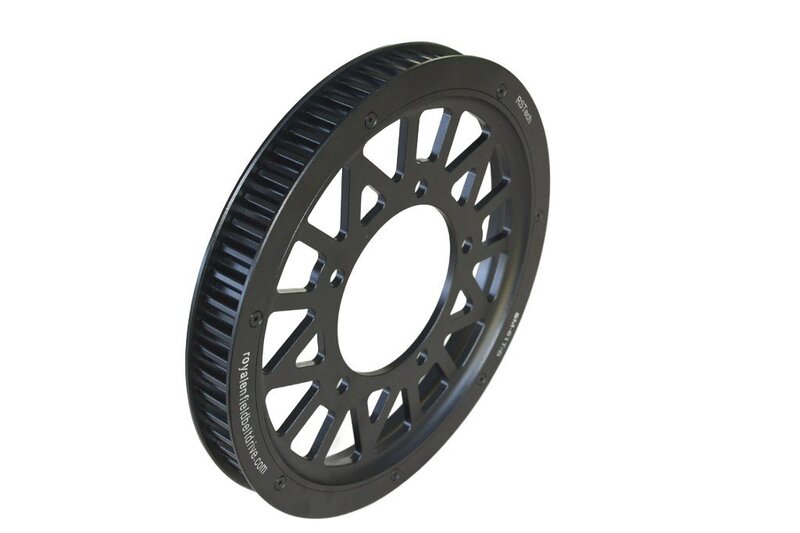
A high quality belt drive conversion kit for the Royal Enfield Interceptor and Continental 650 Twins, consisting of a Gates Poly Chain Carbon GT belt, with both front and rear pullies.
Zero maintenance belt drives have been readily available on production motorcycles since 1981. Quiet, smooth, no chain snatch, no more adjustment issues, no oily mess, no carrying chain lube on a trip, lighter than the chain set, and a lower long term cost due to extended belt and pulley life when compared to a chain drive.
A nice smooth, quiet ride with no mess or fuss. The most common rider comment is on the smoother ride, and effortless gear shifting. This is most noticeable in on/off throttle moments, with a lack of chain snatch in transition from being fully loaded to no load.
THE BELT:
RSTech uses a standard Gates 14mm pitch, high torque, Poly Chain Carbon GT belt, that is readily available from Gates Dealers worldwide. As the name suggests, this belt uses carbon fibre cords with a very high tensile strength, and that for all practical purposes does not stretch.
Described as a positive drive system, the belt teeth engage with the pulley similar to that of a chain, resulting in a very efficient method of transmitting torque. The old adage that a belt is less efficient than a chain is not the case with these modern positive drive belts running at 95-98% efficiency.
Properly lubricated chains running at the higher surface speeds seen on a motorcycle, tend to throw off the oil due to centrifugal forces, making it difficult to maintain proper lubrication at the load bearing. Consequently, chain drives are typically only 92-98% efficient. That performance degrades as the chain wears.
For all practical purposes, a properly maintained, oiled, new chain and a properly tensioned positive drive belt, are the same efficiency. An old, or dry chain, is a different story, and a belt will show greater efficiency on a dyno test.
WEIGHT MATTERS – A lot:
“Simplify and add lightness” is often attributed to Colin Chapman of Lotus fame, and adding weight is the last thing you want in motorcycle design - more so when that weight is un-sprung, and a heavy rotating mass on the wheel, negatively affecting both performance and handling.
RSTech values the importance of a properly engineered rear pulley that “adds lightness” and results in a final drive system that is lighter than the chain set it replaces, thereby improving the handling and performance of your bike.
Adding lightness with an aluminium rear pulley costs more than a steel pulley, and the lightweight rear pulley is a work of art that you will be proud to have on your bike. Fully CNC machined from a solid billet of 6061-T6 aluminium, in a one piece design that assures safety, and a perfect balance for long life and a vibration free ride.
Not a simple cosmetic coating, the rear pulley is Type III hard anodized black. This results in a durable wear surface with a hardness in the mid-50s Rockwell C - the same range as high tensile steel.
The front pulley is engineered to be lightweight, and fully CNC machined from a billet of high tensile steel, and then post machining heat treated for durability on the spline drive. Rather than a cosmetic paint finish, we use a low phosphorus zinc plating for corrosion resistance, and a hardness of 58-62 Rockwell C for additional wear resistance over that provided by the hardened high tensile steel substrate.
You have a choice of two gear ratios when buying a RSTech Super Meteor belt drive kit. Most riders prefer the 16T higher ratio, as there is little noticeable sacrifice in acceleration, with the benefit of lower engine rpm at cruising speeds.
The stock factory gear ratio of 2.6:1 is achieved using a 24/63 pulley. The “16T” higher ratio is 2.5:1. Gearing is a bit confusing with a larger number being lower geared –2.6:1 is lower than the "16T mod" at 2.5:1
A lower gear ratio will accelerate quicker, but theoretical top speed will be lower. At highway speeds the engine will be spinning at a higher speed, and depending how fast you are riding, you may not want to work the engine that hard for very long. Taking that to the extreme, an even lower gear ratio than stock, will have the engine spinning very fast at highway speeds.
A higher gear ratio will accelerate slower, but (theoretical) top speed will be higher only if you have the HP to pull the gearing. Engine rpm at highway speeds will be lower than stock.
The Enfield 650 engine has modest torque and horsepower, so gearing becomes a compromise between acceptable performance, with ones tolerance for higher rpm to keep up with motorway speeds.
Most riders, prefer the 16T gearing as a good all round ratio, with lower engine speed on the highway, and a cruising rpm in the meat of the torque band.
Given that max torque is at 5150 rpm and max hp is at 7250 rpm; how does this math translate into seat of the pants riding:
| kph / mph | rpm stock | rpm "16T" |
|---|---|---|
|
90 / 57 |
3880 |
3660 |
|
100 / 62 |
4330 |
4060 |
|
110 / 68 |
4760 |
4460 |
|
120 / 75 |
5180 |
4870 |
|
130 / 81 |
5610 |
5270 |
|
140 / 87 |
6050 |
5670 |


